LinkedIn automation tools behave very differently from email automation.
LinkedIn-first outbound runs on strict limits, behavioral signals, and account-level trust. When automation goes wrong, results do not just decline. Accounts get throttled, restricted, or flagged.
Early on, most tools appear to work. Connection requests get accepted. Messages go out. Outreach feels efficient. But as volume increases, invisible limits start to surface and performance drops without warning.
This is where LinkedIn automation becomes less about speed and more about control.
Apollo and Salesgear both support linkedin outbound, but they take very different approaches.
One emphasizes reach and data as part of a broader outbound platform.
The other focuses on pacing, guardrails, and long-term account safety for LinkedIn-first motions.
This comparison looks at how each tool handles LinkedIn automation once outbound becomes consistent and team-driven, and which approach holds up better as scale and risk increase.
What LinkedIn-First Outbound Actually Means
LinkedIn-first outbound means LinkedIn is the primary channel where conversations begin, not a follow-up to email.
In this motion, connection requests, profile visits, and LinkedIn messages do the heavy lifting. Email, if it appears at all, supports the conversation instead of leading it.
This distinction matters because LinkedIn operates on behavior, not just volume. Every action is evaluated in context: how frequently connection requests are sent, how quickly messages follow a connection, how repetitive outreach looks, and how recipients engage.
When teams apply email-style automation to LinkedIn, results often degrade quietly.
LinkedIn-first outbound requires:
- slower pacing
- human-like behavior
- strict daily limits
- consistent interaction patterns
Unlike email, there is no true warm-up phase for LinkedIn accounts. Once trust drops, recovery is slow and sometimes permanent.
This is why linkedin automation tools play a much larger role in LinkedIn-first outbound than in email. The tool doesn’t just influence response rates. It influences whether the account remains usable at all.
The Reality of LinkedIn Automation Limits
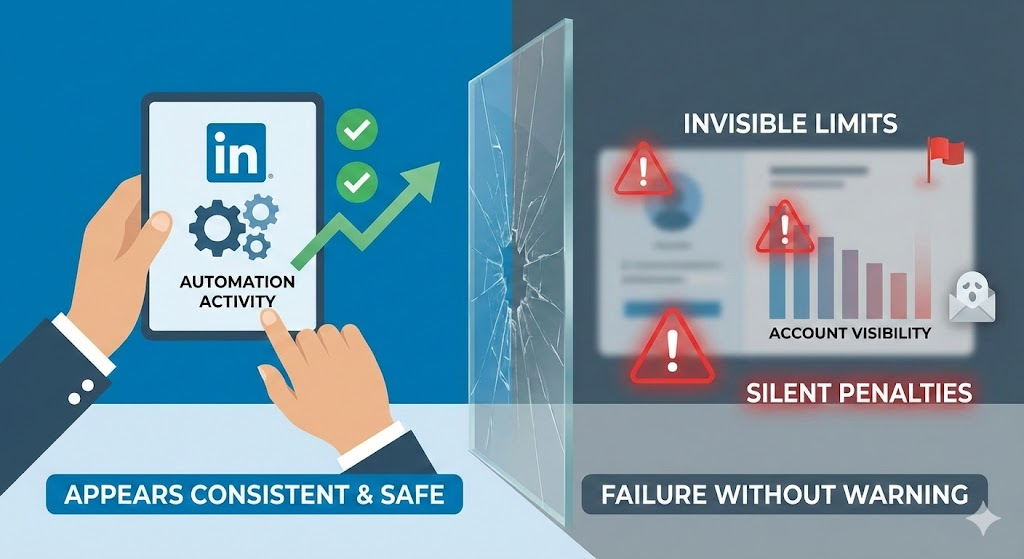
LinkedIn automation breaks not because teams send too many messages, but because they cross limits they never see.
Unlike email, LinkedIn does not publish clear thresholds. There is no dashboard that tells you when you are close to a restriction. Limits are enforced quietly, and penalties are often delayed.
This is where most linkedin automation limits become problematic.
Daily connection requests are capped, but the cap is not fixed. It varies based on account age, past behavior, acceptance rates, and recent activity. The same applies to message sending, profile views, and follow-ups. What worked last week may trigger throttling today.
When teams rely on linkedin outbound tools to scale activity evenly, they often assume consistency is safe.
On LinkedIn, consistency can look automated.
Repetitive actions, predictable timing, and uniform messaging patterns are signals the platform actively watches.
The most dangerous part is that restrictions rarely stop outreach completely. Messages may still be sent. Connection requests may still go out. But delivery, visibility, and response rates drop quietly.
This is why many teams feel like linkedin outreach is not working, even though their automation appears to be running fine.
Account warnings and restrictions usually show up only after trust has already been reduced. By the time a team reacts, the account has already been flagged, and recovery becomes slow and uncertain.
This is also why linkedin automation risks increase sharply as volume grows. Scaling too quickly, especially across multiple reps or accounts, compounds behavior signals instead of distributing them.
On LinkedIn, the margin for error is thin. Automation does not fail loudly. It fails silently, and the cost is often the account itself.
How Apollo Approaches LinkedIn Automation
Apollo approaches LinkedIn outreach as part of a broader outbound platform, not as a LinkedIn-only system.
Its core strength lies in combining contact data, sequencing, and multi-channel outreach in one place. LinkedIn automation is designed to work alongside email and calling, rather than operate independently.
For teams already using Apollo for data and email, this makes apollo linkedin automation convenient to adopt. LinkedIn steps can be added to sequences, messaging can be coordinated with email touches, and activity can be managed from a single workflow.
This works well in early LinkedIn-first experiments.
Apollo enables teams to:
- add LinkedIn connection requests and messages into sequences
- manage outreach across channels without switching tools
- scale activity quickly using predefined steps
For individual users or small teams, this level of integration reduces friction and speeds up execution.
Where Apollo’s approach becomes more complex is at scale.
LinkedIn automation inside Apollo prioritizes workflow efficiency. Safeguards around pacing, behavior variation, and account-level risk depend heavily on user configuration and discipline. The platform assumes teams will monitor performance and adjust activity as needed.
As outbound grows more consistent, this places responsibility on the user to manage linkedin automation risks manually. Without strict internal rules, volume and repetition can creep up faster than account trust can support.
This is why Apollo often works best when LinkedIn is one channel among many, rather than the primary outbound motion.
When LinkedIn-first outbound becomes central, limits and account safety start to matter more than workflow convenience.
Apollo’s strength is reach and integration. Its challenge is that LinkedIn operates on trust, not efficiency.
That tension becomes more visible as teams push LinkedIn automation beyond light usage and into daily, scaled outbound.
Where Apollo’s LinkedIn Automation Starts Breaking
Apollo’s LinkedIn automation usually does not fail immediately. It breaks gradually, and that is what makes the issue harder to diagnose.
Most teams see early traction. Connection requests are accepted. Messages get delivered. Outreach feels productive. Because Apollo integrates LinkedIn into broader sequences, activity looks organized and scalable.
Problems begin once LinkedIn becomes a primary outbound channel, not a supporting one.
The first point of friction is volume. As teams increase daily connection requests and follow-ups, behavior starts to look uniform. Similar actions happen at similar times, across multiple days, often across multiple users. On LinkedIn, repetition is not neutral. It is a signal.
This is where linkedin automation risks begin to surface.
Apollo’s workflows are efficient, but LinkedIn rewards irregular, human-like behavior. Without strong pacing controls, outreach can become predictable even if message content is personalized. Predictability, not intent, is what LinkedIn penalizes.
The second issue is visibility. When LinkedIn engagement drops or delivery becomes inconsistent, Apollo does not clearly surface account-level health. Teams often interpret declining results as a messaging problem rather than an automation problem.
This is why many users reach a point where linkedin outreach is not working, even though campaigns are still active.
The third pressure point is team scaling. When multiple reps use the same system, behavior patterns compound. Small inefficiencies repeat across accounts. Limits are crossed faster. Risk spreads more easily.
Apollo assumes users will recognize these signals and manually slow down. In practice, most teams realize something is wrong only after restrictions or warnings appear.
At that stage, the issue is no longer optimization. It is recovery.
Apollo works best when LinkedIn automation is light, controlled, and secondary. Once teams push it as a LinkedIn-first engine, the gap between workflow efficiency and account safety becomes difficult to ignore.
What Safe LinkedIn Automation Actually Requires
Safe LinkedIn automation is not about avoiding automation. It is about controlling how automation behaves.
LinkedIn evaluates patterns over time. It does not just look at how much activity happens, but how consistently it happens, how predictable it looks, and how recipients respond. Any automation strategy that ignores this eventually runs into limits.
This is why linkedin automation tools need to prioritize safety over speed.
The first requirement is pacing. Actions must be spread out in a way that mirrors human behavior. Sudden bursts of activity, even if they stay under theoretical limits, increase risk. Delays between actions matter as much as daily totals.
The second requirement is variation. Safe linkedin outbound does not repeat the same sequence of actions every day. Timing, order, and intensity need to fluctuate naturally. Consistency is efficient, but efficiency is not what LinkedIn rewards.
The third requirement is restraint. Scaling LinkedIn outreach is less about doing more and more about knowing when to slow down. When engagement drops, safe automation reduces pressure instead of compensating with volume.
This is where many tools fail. They treat automation as execution, not as behavior management.
Another critical requirement is account-level protection. LinkedIn does not penalize campaigns. It penalizes accounts. Once trust degrades, it affects everything tied to that profile. Recovery is slow, and sometimes incomplete.
That is why linkedin automation for sales must treat account safety as a constraint, not an afterthought.
Safe LinkedIn automation also requires clear boundaries for teams. Individual discipline does not scale well. Systems need built-in guardrails so that mistakes do not repeat across reps and accounts.
Ultimately, LinkedIn automation works best when it feels slightly conservative. It trades speed for longevity. Teams that accept this tend to see steadier results, fewer disruptions, and less need to reset accounts.
The tools that hold up over time are not the ones that automate the most actions. They are the ones that know when not to automate.
How Salesgear Handles LinkedIn-First Outbound
Salesgear approaches LinkedIn-first outbound with a different assumption: LinkedIn is not just another channel to automate. It is a fragile environment where small behavioral mistakes compound quickly.
Instead of treating LinkedIn automation as a way to increase activity, Salesgear treats it as a way to control behavior at scale.
That distinction shapes everything else.
LinkedIn Is Treated as a High-Risk Channel by Default
Salesgear assumes that LinkedIn accounts are easy to damage and slow to recover.
Because of that, LinkedIn outreach is designed to move deliberately. Actions are paced, spread out, and constrained so that activity never spikes unnaturally, even when teams want to move faster.
This is especially important for LinkedIn-first outbound, where the account itself is the asset. Once trust drops, there is no equivalent of switching inboxes or warming a new domain.
By default, Salesgear favors consistency over intensity. It is built to support long-term LinkedIn usage rather than short bursts of aggressive outreach.
Automation Is Built Around Guardrails, Not Throughput
Salesgear does not try to maximize how many LinkedIn actions can be automated in a day.
Instead, it focuses on:
- keeping action frequency within safe ranges
- spacing activities to avoid detectable patterns
- avoiding repetitive, machine-like behavior
This makes LinkedIn automation feel slower than tools that prioritize speed. Over time, it holds up better because it reduces the likelihood of throttling, warnings, or restrictions.
For teams running LinkedIn outbound daily, this trade-off matters more than raw volume.
Behavior Matters More Than Sequences
In LinkedIn-first outbound, how actions happen matters as much as what actions happen.
Salesgear places more emphasis on behavior patterns than on rigid sequencing. LinkedIn outreach is structured to look natural across days, not just correct within a single sequence.
This helps avoid one of the most common failure modes of LinkedIn automation: perfectly organized outreach that looks unnatural when viewed at the account level.
Instead of optimizing for efficiency, the system optimizes for credibility.
Account Safety Scales Better Than Manual Discipline
One of the biggest challenges with LinkedIn automation is that discipline does not scale well across teams.
Different reps push limits differently. Small changes repeat across accounts. What feels safe for one user becomes risky when multiplied across ten.
Salesgear reduces this risk by embedding constraints directly into how LinkedIn outreach runs. The system limits how much damage can be done even when users push boundaries.
This is particularly valuable for teams where LinkedIn-first outbound is shared across multiple people and accounts.
LinkedIn and Email Are Coordinated, Not Competing
Salesgear does not isolate LinkedIn outreach from the rest of outbound. It treats LinkedIn as one part of a broader, coordinated motion.
This matters because LinkedIn-first outbound often works best when pressure is distributed. Not every follow-up needs to happen on LinkedIn. Not every touch needs to be automated.
By coordinating LinkedIn activity with other channels, Salesgear helps reduce over-reliance on LinkedIn actions alone, which is another common cause of account stress.
The Outcome Is Predictability, Not Speed
Salesgear’s LinkedIn-first approach does not promise faster results. It aims for steadier ones.
Teams using this model tend to see:
- fewer sudden drops in response rates
- less unexplained throttling
- more consistent account performance over time
Automation feels controlled rather than aggressive. Growth feels incremental rather than spiky.
For teams that depend on LinkedIn as a core outbound channel, this kind of predictability often matters more than early acceleration.
A Different Philosophy, Not Just Different Features
Salesgear’s LinkedIn-first outbound approach is not defined by a single feature. It is defined by restraint.
It assumes that LinkedIn rewards patience, variation, and human-like behavior, and it builds automation around those constraints instead of fighting them.
That makes it less exciting at the start, but more reliable once LinkedIn outbound becomes part of daily revenue motion.
Apollo vs Salesgear: LinkedIn Automation Compared
Apollo and Salesgear both support LinkedIn outreach, but they are built for different assumptions about how LinkedIn should be used.
The difference is not about whether LinkedIn can be automated. It is about how much risk a system is willing to tolerate in exchange for speed and scale.
That distinction becomes clearer as LinkedIn-first outbound matures.
Automation Depth vs Automation Control
Apollo’s strength lies in breadth. It brings LinkedIn into a broader outbound workflow alongside email, calling, and data enrichment. For teams already using Apollo as their system of record, this makes LinkedIn automation easy to adopt.
LinkedIn steps can be added to sequences quickly. Outreach feels unified. Execution scales fast.
Salesgear takes a narrower but more controlled approach. LinkedIn automation exists, but it is intentionally constrained. The system is less focused on how many actions can be automated and more focused on how those actions behave over time.
This is the core linkedin automation tools trade-off:
- Apollo optimizes for reach and workflow efficiency
- Salesgear optimizes for pacing, safety, and repeatability
Speed vs Longevity
Apollo enables teams to move quickly. That speed is useful in early LinkedIn-first experiments, where learning matters more than stability.
As volume increases, however, speed becomes a liability. LinkedIn rewards irregular, human-like behavior. Systems that execute too consistently or aggressively begin to attract attention.
Salesgear is designed with this in mind. It favors slower ramp-up, spaced actions, and behavioral variation. Outreach feels less aggressive, but it tends to last longer without triggering limits or restrictions.
For teams running linkedin outbound daily, longevity often matters more than initial acceleration.
Visibility Into Risk
One of the biggest differences between the two platforms is how risk is surfaced.
Apollo assumes users will interpret declining results and adjust behavior manually. When LinkedIn engagement drops, it is not always clear whether the issue is messaging, targeting, or automation pressure.
Salesgear places more emphasis on controlling risk before performance collapses. Instead of waiting for visible failure, it limits how quickly automation can escalate in the first place.
This reduces the likelihood of teams reaching the point where linkedin outreach is not working and recovery becomes the main task.
Scaling Across Teams
Apollo works well for individual users and small teams where behavior is tightly controlled.
As more reps are added, patterns compound. Similar workflows repeated across multiple accounts can trigger linkedin automation risks faster than expected. At that stage, discipline becomes the primary safeguard.
Salesgear is designed to absorb this kind of scale more safely. By embedding guardrails into the system, it reduces the impact of individual mistakes and limits how much any single account can be pushed.
This difference becomes especially important for teams running LinkedIn-first outbound across multiple reps.
Flexibility vs Predictability
Apollo offers flexibility. Teams can experiment, adjust workflows, and push volume as needed. This is valuable in fast-moving environments where LinkedIn is one of several channels.
Salesgear offers flexibility along with predictability. Outreach behaves more conservatively, but results tend to be steadier over time.
Neither approach is inherently better. They serve different stages of outbound maturity.
The Practical Difference
In practice, Apollo feels better when LinkedIn automation is light, opportunistic, and part of a broader outbound mix.
Salesgear feels better when LinkedIn is a primary channel, and account safety is non-negotiable.
Teams that prioritize speed and experimentation often start with Apollo. Teams that prioritize consistency and long-term LinkedIn usage often move toward systems with stronger controls.
That difference is not philosophical. It is operational.
Feature Comparison: Apollo vs Salesgear for LinkedIn Automation
| Category | Apollo | Salesgear |
| Primary use case | Broad outbound platform (data + email + LinkedIn) | LinkedIn-first and outbound-safe engagement |
| LinkedIn automation philosophy | Workflow efficiency and scale | Controlled automation with safety guardrails |
| LinkedIn as primary channel | Supported, but not optimized for | Designed to support LinkedIn-first outbound |
| Automation depth | High flexibility in sequences | Selective automation focused on safe behavior |
| Pacing & delays | Largely user-configured | System-enforced pacing to reduce risk |
| Behavior variation | Depends on user setup | Designed to avoid repetitive patterns |
| Daily activity limits | Advisory, not enforced | Enforced limits to prevent overuse |
| Account safety focus | Assumes user discipline | Built-in constraints to protect accounts |
| Visibility into LinkedIn risk | Limited, indirect | Risk reduced through prevention, not alerts |
| Scaling across reps | Requires strict internal rules | Scales with lower reliance on manual discipline |
| Recovery from restrictions | Manual slowdown and resets | Fewer incidents due to conservative defaults |
| Best for | Individuals or teams running LinkedIn as one of many channels | Teams running LinkedIn-first outbound at scale |
| Typical failure mode | Outreach slows without clear reason | Slower ramp-up but steadier long-term performance |
How to read this table (important context)
This comparison is not about feature quantity.
It reflects how each system behaves under pressure:
- when volume increases
- when multiple reps are involved
- when LinkedIn becomes a daily outbound channel
Apollo optimizes for speed and integration across channels.
Salesgear optimizes for predictability and account longevity on LinkedIn.
Neither approach is wrong. They solve different problems at different stages.
Pricing Reality for LinkedIn Automation
Pricing for linkedin automation tools looks simple until LinkedIn becomes your main outbound channel. Then the real cost is not just seats. It’s the cost of scaling activity without triggering slowdowns, restrictions, or wasted effort.
Here’s what Apollo and Salesgear cost on paper, and what that usually means in practice.
Apollo pricing (what you’ll typically pay)
Apollo’s public pricing is commonly presented in tiers:
- Free: $0
- Basic: $49/user/month
- Professional: $79/user/month
- Organization: $119/user/month (often listed with a minimum of 3 users)
If you pay monthly (instead of annual), third-party breakdowns typically place Apollo in the ~$59 to $149 per user/month range depending on tier.
What this means for LinkedIn-first outbound:
Apollo’s cost scales mostly with users and usage. It works well when LinkedIn is one channel among many because it’s designed as a broader outbound platform.
But when LinkedIn becomes the main channel, teams often end up “paying” in operational overhead: monitoring performance drops, tweaking volume, rotating reps, and trying to diagnose why linkedin outreach is not working even though workflows look fine.
Salesgear pricing (what you’ll typically pay)
Salesgear’s pricing is straightforward and credit-based, with monthly tiers shown on the pricing page:
- Free: $0/month (includes 50 credits/month)
- Basic: $49/month (includes 1,200 credits/month)
- Pro: $99/month (includes 4,000 credits/month)
- Pro Plus: $199/month (includes 10,000 credits/month) SalesGear
Salesgear also clarifies that credits are shared across actions (email, phone, deep research) and that Outreach plans include the engagement platform (email automation, calling, LinkedIn, CRM integrations). SalesGear
What this means for LinkedIn-first outbound:
Salesgear’s pricing tends to stay predictable because the product’s approach is more guardrail-driven.
You are not just paying for access; you are paying for a system that is designed to keep activity controlled as you scale.
The “real pricing” question for LinkedIn automation tools
If LinkedIn is your primary outbound channel, the decision isn’t “$49 vs $99.”
The better question is:
- Can this system scale LinkedIn activity without increasing account risk?
- How much time will we spend troubleshooting throttling and drops?
- Will our output still be consistent three months from now?
Apollo often wins on consolidation and speed when LinkedIn is one piece of a multichannel motion.
Salesgear wins when LinkedIn-first outbound needs to stay steady, team-driven, and sustainable.
When Apollo Still Makes Sense
Apollo makes sense when LinkedIn automation is a means, not the strategy itself.
In some outbound motions, LinkedIn is not where momentum is built. It is where conversations are nudged forward. In those cases, the requirements for safety, pacing, and longevity are lower.
That is the context where Apollo performs best.
When LinkedIn Is Used Sparingly, Not Continuously
Apollo fits teams that touch LinkedIn occasionally rather than rely on it daily.
If LinkedIn activity:
- supplements email or calling
- happens in short, controlled windows
- is not expected to run uninterrupted for months
then the risks associated with LinkedIn automation stay limited. Automation supports productivity, but does not define the outbound motion.
In this setup, Apollo’s flexibility works in its favor.
When Centralization Matters More Than Specialization
Some teams value having everything in one place more than optimizing any single channel.
For them, Apollo’s appeal is not LinkedIn automation itself. It is consolidation.
LinkedIn, email, data, and sequencing live inside one system. Outreach feels unified, even if no single channel is pushed aggressively. This reduces tooling complexity and speeds up execution.
When LinkedIn is not the primary growth lever, this trade-off is reasonable.
When Outbound Is Still Being Shaped
Apollo also works well when outbound is still evolving.
Teams that are:
- defining their ICP
- refining messaging
- experimenting with channels
often benefit from flexibility more than restraint. They need to move fast, test ideas, and change direction quickly.
In this phase, LinkedIn automation is exploratory. The cost of missteps is lower because volume and expectations are still limited.
When Risk Is Intentionally Accepted
Every outbound motion carries risk. The difference is whether that risk is accidental or deliberate.
Apollo suits teams that knowingly accept LinkedIn automation risk in exchange for speed and convenience. This is often a conscious decision, not a mistake.
As long as that risk remains contained, the system works.
The Boundary That Matters
Apollo stops making sense when LinkedIn is expected to perform consistently, not occasionally.
Once LinkedIn-first outbound becomes part of the weekly rhythm, the question changes from “How quickly can we run outreach?” to “How long can we keep this running?”
Apollo answers the first question well.
The second requires a different kind of system.
When Salesgear Is the Better Choice
Salesgear becomes the better choice when LinkedIn outbound stops being a set of actions and starts behaving like a system.
At this stage, teams are not optimizing individual messages or connection requests. They are optimizing how LinkedIn fits into a repeatable outbound workflow without constant manual effort or platform hopping.
That shift favors systems that are designed to operate inside LinkedIn’s constraints rather than around them.
When LinkedIn Is the Source of Truth, Not Just a Touchpoint
Salesgear fits teams that treat LinkedIn as the starting point for outbound, not a secondary channel.
Instead of exporting lists or copying profiles between tools, teams can pull contacts directly from LinkedIn Sales Navigator into Salesgear. This keeps prospecting anchored to LinkedIn itself, rather than turning it into a disconnected data source.
For LinkedIn-first outbound, this reduces friction and preserves context. Reps work from the same profiles they research, rather than rebuilding lists elsewhere.
When Outreach Needs to Run Without Tab Switching
Salesgear is better suited for teams that want LinkedIn outreach to happen without constantly moving between tools.
Once a LinkedIn account is connected, Salesgear handles:
- sending connection requests
- delivering LinkedIn messages
- progressing outreach automatically based on sequence logic
This allows LinkedIn automation to run in the background, without requiring reps to manually execute each step.
At the same time, outreach stays paced and controlled, which matters when LinkedIn activity is happening daily rather than occasionally.
When Prospecting and Outreach Need to Stay Connected
In many LinkedIn workflows, prospecting and engagement happen in separate tools. That separation creates extra steps and increases the chance of inconsistent behavior.
Salesgear’s Chrome extension helps bridge that gap.
From within LinkedIn, reps can:
- find verified email addresses and phone numbers
- add contacts directly into Salesgear
- place contacts into sequences without leaving the page
This keeps LinkedIn-first outbound efficient without encouraging excessive activity. Prospecting, enrichment, and sequencing remain part of one flow.
When Teams Need Systems, Not Manual Discipline
As teams grow, relying on individual judgment becomes risky.
Salesgear fits environments where LinkedIn outbound is shared across multiple reps and needs to behave consistently. By embedding constraints into how outreach runs, the system reduces reliance on manual rule-setting.
Reps do not have to decide how hard to push LinkedIn each day. The system already assumes that restraint is safer than acceleration.
This is especially useful for managers who want LinkedIn automation to scale without introducing account-level surprises.
When LinkedIn Outbound Needs to Age Well
Salesgear works best for teams that expect LinkedIn outbound to run continuously over time.
Because contacts flow directly from Sales Navigator, outreach is automated but paced, and prospecting stays connected to engagement, the system is built to support longevity rather than bursts.
The result is not maximum throughput. It has fewer resets, fewer interruptions, and more predictable use of LinkedIn as a channel.
A Practical Fit, Not a Feature Comparison
Salesgear’s advantage in LinkedIn-first outbound does not come from doing more things. It comes from reducing unnecessary movement, unnecessary decisions, and unnecessary risk.
For teams that want LinkedIn to function as a reliable, long-term outbound channel, that kind of quiet efficiency often matters more than flexibility.
Final Verdict: Choosing the Right LinkedIn Automation Tool
Choosing between LinkedIn automation tools is less about features and more about intent.
Apollo and Salesgear are both capable platforms, but they are built for different operating realities. One prioritizes speed, reach, and flexibility inside a broader outbound motion. The other prioritizes control, consistency, and long-term use of LinkedIn as a primary channel.
That difference matters most after the early wins fade.
When LinkedIn outreach is occasional or experimental, workflow efficiency tends to win. Fast setup, integrated sequencing, and broad coverage are useful when teams are still testing where LinkedIn fits.
When LinkedIn becomes central to outbound, the question changes. Reliability matters more than velocity. Account safety matters more than throughput. Systems that assume restraint tend to last longer than systems that assume discipline.
This is where the gap between automation and sustainable automation becomes visible.
Salesgear’s approach is not about doing more on LinkedIn. It is about doing enough, consistently, without creating downstream problems that stall outreach later. By keeping prospecting, enrichment, and automation tightly connected, and by operating within LinkedIn’s behavioral limits, it favors longevity over acceleration.
Apollo remains a strong choice for teams that value consolidation and flexibility, especially when LinkedIn is one channel among many. Salesgear is a stronger fit when LinkedIn-first outbound needs to run week after week, across reps, without constant adjustment.
The right choice depends on how important LinkedIn is to your outbound motion, and how long you expect it to run without interruption.
For teams that want LinkedIn to compound quietly rather than spike and reset, systems built around control tend to win over time.