Best B2B Data Enrichment Tools for CRM Accuracy (2026)

TL;DR: The best B2B data enrichment tools for CRM accuracy in 2026 are not the ones with the biggest databases, they’re the ones with the highest verified match rate for your ICP. No single provider covers more than ~70% of any list, so accuracy comes from verification, coverage, and freshness, not brand. This guide ranks 15 leading tools (ZoomInfo, Cognism, Apollo, Clay, Clearbit/Breeze, UpLead, Lusha, BetterContact, Salesgear and more) with tested accuracy numbers, real pricing models, and a decision framework for choosing by use case.
Your CRM is only as good as the data inside it, and B2B data goes stale fast. Contact records decay 22-70% per year, which means even a perfectly clean import degrades within months. B2B data enrichment tools fix that: they append and verify the missing fields, email, direct-dial and mobile numbers, title, firmographics, technographics, so reps can actually reach the right people.
But not all enrichment is equally accurate, and “accuracy” is exactly where most buyers get burned. Vendors advertise 95%+ accuracy; independent cross-vendor testing routinely finds 65-80% real-world accuracy for the same platforms. This guide explains what actually drives CRM data accuracy, ranks the leading tools by tested performance, and shows you how to pick the right one for your team.
What is B2B data enrichment?
B2B data enrichment is the process of appending, updating, and verifying missing or outdated information in your CRM records, such as business emails, direct-dial phone numbers, job titles, company size, industry, and technology stack, by matching your records against external data sources.
There are four main types:
- Contact data enrichment, appending person-level fields: verified email, mobile/direct dial, title, seniority, LinkedIn profile.
- Company (firmographic) enrichment, appending account-level fields: industry, headcount, revenue, location, funding, tech stack.
- Lead enrichment, enriching inbound leads in real time (e.g., a form fill with just an email) so routing and scoring work correctly.
- Email enrichment / verification, finding and validating deliverable email addresses specifically, usually with MX-record and catch-all checks.
What is lead enrichment vs data enrichment? Lead enrichment is a subset of data enrichment focused on new inbound leads at the moment of capture; data enrichment covers your entire CRM, including existing accounts and contacts that have decayed since entry.
Why CRM accuracy is the real problem
The reason enrichment exists at all is decay. B2B contact data decays at 22-70% per year depending on industry and role; Dun & Bradstreet estimates roughly 30-40% annually, and email addresses alone go bad at about 3.6% per month (Landbase). People change jobs, companies rebrand, merge, and move, and every one of those events silently invalidates a CRM field.
The cost of ignoring it is well documented:
- Gartner estimates poor data quality costs the average organization $12.9M per year.
- Sales reps lose roughly 546 hours per rep per year, about 27.3% of their time, chasing bad or missing data.
- Organizations attribute up to 37% of lost revenue to data quality problems (Coffee.ai).
Multiply a 30% annual decay rate against a 50,000-record CRM and the math is stark: without enrichment, ~15,000 records go bad every year. That’s the pipeline your reps are dialing into.
What makes a data enrichment tool actually accurate
Vendors love headline accuracy claims. Independent testing tells a more honest story: in a 1,000-contact benchmark run by Cleanlist, tested email accuracy ranged from ~98% at the top down to 65-80% for several self-serve platforms that claim 95%+. Four things separate genuinely accurate enrichment from marketing copy:
1. Verification, not just retrieval. A real tool validates every result, MX-record checks, catch-all detection, SMTP handshake, before it enters your CRM, rather than serving a cached guess from a static database.
2. Coverage via multiple sources. No single provider exceeds ~70% coverage of any given list (Cognism). A single source typically matches 40-60% of records; chaining 3-5 sources (waterfall enrichment, more below) lifts match rates to 85-95%.
3. Freshness. Because data decays monthly, accuracy depends on when the record was last verified. Real-time verification at the moment of lookup beats a database refreshed quarterly.
4. Don’t overwrite good data. This is the CRM best practice most teams miss: enrichment should check whether a valid, recently verified value already exists in Salesforce or HubSpot and skip that field, filling gaps rather than clobbering known-good data. Any tool worth deploying supports “never overwrite non-empty fields” behavior, ideally with field-level rules.
Contact data enrichment techniques worth asking every vendor about: waterfall sequencing, real-time SMTP/MX verification, catch-all scoring, phone verification (human- or connect-verified vs scraped), triangulation across sources, and change-detection (job-change alerts).
Waterfall vs single-source vs real-time enrichment
This is the single biggest accuracy lever, so it deserves its own section.
Single-source enrichment queries one database for every field. It’s simple and cheap, but you inherit that provider’s coverage ceiling: typically a 40-60% match rate, and no provider exceeds ~70% coverage of a full list.
Waterfall enrichment queries multiple providers in sequence for each record: if provider A returns nothing verified, the record falls through to B, then C, stopping when verified data is found. Because each provider’s coverage gaps are different, chaining 3-5 sources lifts match rates to 85-95% (Cognism, Amplemarket). Independent tests back this up: one six-week Reddit test found Apollo alone hit ~65% accuracy, ZoomInfo ~75%, and a waterfall approach reached 88%.
The coverage math, simplified: if each of three independent sources covers ~60% of your list, the probability that none of them has a given record is 0.4 × 0.4 × 0.4 = 6.4%, i.e., a theoretical ~93% combined match rate. Real-world overlap between databases lowers that a bit (many providers license the same underlying data), which is why 85-95% is the realistic waterfall range.
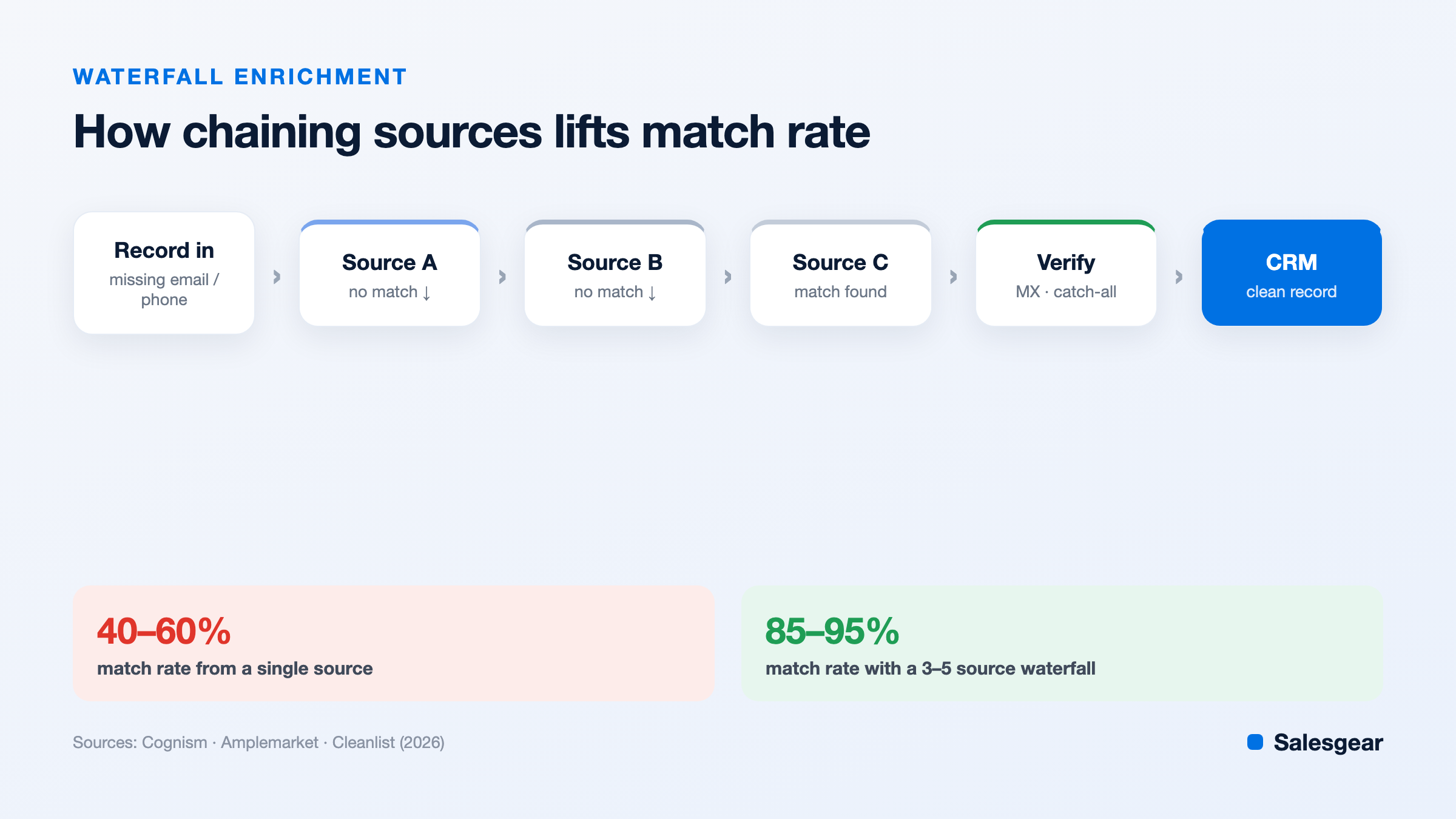
Real-time enrichment verifies at the moment you request the contact rather than serving cached data, critical when deliverability matters (cold email) and freshness beats cache.
| Approach | How it works | Match rate | Best when |
|---|---|---|---|
| Single source | One database for every field | 40-60% | Your ICP sits squarely in one provider’s sweet spot |
| Waterfall | Chain 3-5 providers in sequence until verified | 85-95% | Coverage matters and you have volume |
| Real-time | Verify at the moment of lookup | Varies by source | Deliverability is critical; freshness beats cache |
Two caveats before you assume “more sources = better.” First, ~98% of email-finding tools draw on overlapping underlying databases, so a 20-source waterfall isn’t 20 independent sources. Second, a Dropcontact benchmark of 20,000 tests found some waterfall tools trade coverage for error rate, more matches, but more wrong matches. Start your waterfall with your most accurate source, and verify everything at the end.
Most teams end up blending all three: a strong primary source matched to their ICP, waterfall fallback for the gaps, and real-time verification before anything sends.
The best B2B data enrichment tools for CRM accuracy in 2026
Here’s how the leading tools compare. “Tested accuracy” reflects the independent 1,000-lead email benchmark where available; a dash means the tool wasn’t in that specific test, not that it’s inaccurate. Pricing is indicative as of mid-2026; confirm current figures with each vendor.
| # | Tool | Best for | Tested email accuracy | Pricing model | Free tier | G2 |
|---|---|---|---|---|---|---|
| 1 | Salesgear | Outbound teams: verified dials + research + sending in one | – | Credit-based; free tier, from $49/mo | Yes | – |
| 2 | ZoomInfo | US enterprise depth, intent, technographics | ~85% | Enterprise contract, credits | No | 4.5 |
| 3 | Cognism | EMEA phone-verified mobiles, GDPR-first | ~90% | Custom/seat-based, generous credits | No | 4.5-4.6 |
| 4 | Apollo | All-in-one database + sequencing on a budget | ~80% | From $49/user/mo, credits | Yes | 4.7 |
| 5 | Clay | Build-your-own waterfall + workflows | 85-95% (waterfall) | From $185/mo + credits | Limited | 4.8 |
| 6 | Clearbit / HubSpot Breeze | Native enrichment inside HubSpot | ~85% | Credit-metered (~$700/10k, expire monthly) | No | 4.4 |
| 7 | Cleanlist | Highest tested accuracy, managed cleaning | ~98% | Managed / per-record | Trial | n/a* |
| 8 | UpLead | Verified data with a 95% accuracy guarantee | – | From $74/mo, credit refunds on bounces | Trial | 4.7 |
| 9 | BetterContact | Plug-and-play waterfall (email + phone) | 87-95% find rate (waterfall) | From $15/mo, pay-only-for-valid | 50 credits | 4.8 |
| 10 | Lusha | Simple self-serve LinkedIn prospecting | – | From ~$29/user/mo, credits | Yes | 4.3 |
| 11 | LeadIQ | SDR workflow: LinkedIn → CRM + job-change alerts | – | Freemium; quote-based credits at scale | Yes | 4.2 |
| 12 | RocketReach | Broad lookup coverage (700M+ profiles) | – | Credit tiers; higher tiers ~$359/mo | 5 lookups/mo | 4.4 |
| 13 | Seamless.ai | Real-time AI lead search at volume | – | Freemium; opaque Pro/Enterprise pricing | Yes | 4.2-4.4 |
| 14 | People Data Labs | API-first enrichment for builders | – | Pay-per-record API | Dev tier | n/a* |
| 15 | FullContact | Identity resolution / person API | – | Custom API pricing | Trial | n/a* |
1. Salesgear, best for outbound teams that want reachable data and the ability to act on it
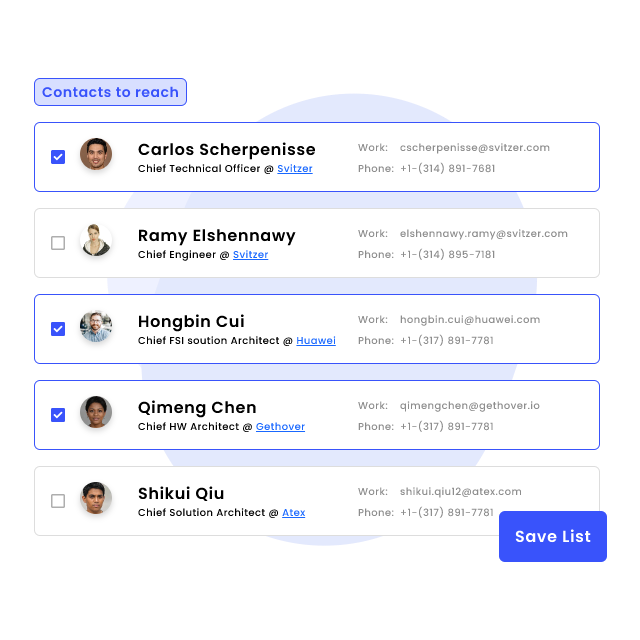
Salesgear pairs verified emails and direct-dial/mobile numbers with Deep Research signals and built-in multi-channel sending (email, phone, LinkedIn), syncing enriched data back to Salesforce, HubSpot, Zoho, or Pipedrive. Instead of stitching together a database, a sequencer, and a dialer, outbound teams get reachable data, why-now context, and execution in one place.
- Best for: Outbound/SDR teams that need verified direct dials plus research and sending, synced to the CRM.
- Pricing: Free tier (50 credits/mo); paid from $49/mo (Basic) and $99/mo (Pro), full features on every plan. Free tier available.
- Accuracy/coverage: verified emails and 95% direct-dial/mobile accuracy (Salesgear-reported; not part of the third-party email benchmark above)
- Watch-out: Best suited to teams running an active outbound motion; if you only need firmographic fill for marketing ops, a pure data layer may be cheaper.
See how it fits a full workflow in our sales prospecting guide and Deep Research overview.
2. ZoomInfo, best for US enterprise depth
The largest B2B database, 500M+ contacts, 100M+ companies, 135M+ verified phone numbers, with the deepest firmographic, intent, and technographic layers, plus analyst validation (Gartner MQ and Forrester Wave placements) that matters in enterprise procurement.
- Best for: US-centric enterprise and mid-market teams that need intent data, org charts, and breadth.
- Pricing: Enterprise contracts, annual commitments, credit-metered exports (a company + contact export can burn double credits).
- Tested accuracy: ~85% in the 1,000-lead benchmark; independent tests put real-world phone accuracy around 75%.
- Watch-out: Cost and contract rigidity; coverage weakens meaningfully outside North America (the international Data Passport is a paid add-on).
3. Cognism, best for EMEA and phone-verified mobiles
The premium European choice: GDPR-first compliance, DNC screening across 15 countries, and Diamond-verified phone data reporting an 87% connect rate and 93%+ email deliverability. Reported 440M+ contacts with European depth as its strongest asset.
- Best for: Teams selling into EMEA, or any team where mobile connect rate is the KPI.
- Pricing: Custom (no public dollar amounts); transparent credit allowances by seat.
- Tested accuracy: ~90% email in the benchmark.
- Watch-out: Premium pricing, no native sequencing (pairs with Outreach/Salesloft), and quality outside the Diamond-verified subset is more ordinary.
4. Apollo, best all-in-one on a budget
A 230M+ contact database bundled with sequencing, a parallel dialer, and AI agents, plus a genuinely useful free tier. The default choice for startups and SMBs, with a 4.7 G2 rating across 9,000+ reviews.
- Best for: SMB/startup teams that want data + outreach in one tool from day one.
- Pricing: Free tier; paid from $49/user/month (annual). Emails and phones cost separate credits; mobile credits are capped even on top plans.
- Tested accuracy: ~80% in the benchmark; user reports cluster at 65-80%, with phone accuracy heavily region-dependent.
- Watch-out: The credit model gets expensive and confusing at scale, and European coverage is uneven versus specialists.
5. Clay, best for build-your-own waterfall workflows
Not a database but an orchestration layer: Clay chains 100+ providers, AI research agents, and CRM triggers into custom enrichment workflows, lifting match rates from single-source 40-60% to waterfall-grade 85-95%.
- Best for: RevOps teams with a technical operator who wants maximum control.
- Pricing: After the March 2026 overhaul, Launch $185/mo (2,500 data credits + 15,000 actions), Growth $495/mo. You aren’t charged when an enrichment returns nothing.
- Watch-out: Setup-heavy with a real learning curve; the dual-currency (credits + actions) pricing is easy to overspend on, and you’re still paying for the underlying vendors.
6. Clearbit / HubSpot Breeze Intelligence, best native HubSpot enrichment
Clearbit is now HubSpot’s Breeze Intelligence, enriching company and contact data natively inside the CRM at ~85% tested accuracy, the strongest argument for “just turn it on” if you live in HubSpot.
- Best for: HubSpot-centric teams that mainly need firmographic and form-shortening enrichment.
- Pricing: Credit-metered, roughly $700 per 10,000 credits at ~10 credits per record, and credits expire monthly; the best tiers effectively require Pro (~$800/mo).
- Watch-out: Thin direct-dial/mobile coverage, so outbound teams usually still add a phone-data layer. (Zoho’s equivalent, Zia enrichment, is Enterprise/Ultimate-only, credit-limited, and firmographic, no direct dials.)
7. Cleanlist, highest tested accuracy
Cleanlist posted the highest tested email accuracy (~98%) in its 1,000-lead benchmark, with a managed cleaning-and-enrichment approach and an internal test showing single-source coverage of 62% jumping to 98% with its waterfall.
- Best for: Teams where accuracy is the single priority and a managed service is acceptable.
- Pricing: Managed / per-record.
- Watch-out: It ran the benchmark it tops, and it has essentially no G2 review base, validate on your own data before trusting the pipeline to it.
8. UpLead, best accuracy guarantee
UpLead’s differentiator is contractual: a 95% data accuracy guarantee with credit refunds on bounces, backed by real-time email verification at the moment of download. 4.7 on G2 across 800+ reviews.
- Best for: SMB and mid-market teams that can’t afford bounces and want transparent public pricing.
- Pricing: From $74/month (annual), credit-based; free trial.
- Watch-out: Smaller database than ZoomInfo/Apollo, and credit volumes at lower tiers can pinch high-volume teams.
9. BetterContact, best plug-and-play waterfall
BetterContact runs your list through 20+ providers (Apollo, RocketReach, Hunter, Datagma, People Data Labs, Prospeo, Enrich.so and more) in an AI-optimized sequence, verifies every result, and only charges for valid data. Users report 87-95% email find rates and strong EU phone coverage. 4.8 on G2.
- Best for: Teams that want waterfall coverage without building it in Clay.
- Pricing: Starter $15/mo (200 credits), Pro $49/mo (1,000 credits); phones cost 10 credits vs 1 for email.
- Watch-out: Sequential API queries make enrichment slow (minutes, not seconds); integrations are limited; phone-heavy workflows burn credits fast. Adjacent single-source specialists worth knowing in this niche: Findymail (verified emails, sub-5% bounce guarantee, from $99/mo), Prospeo (~98% claimed email accuracy at ~$0.01/email), and Datagma (emails + phone waterfall source, popular inside Clay).
10. Lusha, simplest self-serve prospecting
A polished Chrome extension that reveals emails and direct dials from LinkedIn profiles, with SOC 2 Type II and GDPR/CCPA positioning. Ideal first tool for a small team.
- Best for: SMB reps prospecting one profile at a time on LinkedIn.
- Pricing: Free tier; paid from ~$29/user/month. Phone reveals cost 10 credits vs 1 for email, “480 credits” is 48 phone numbers.
- Watch-out: 4.3 on G2 but 1.4 on Trustpilot; recurring complaints about credit burn, mobile accuracy outside core regions (60-65% in broader markets), and upgrade/downgrade friction. Bulk enrichment caps at 25 contacts per batch.
11. LeadIQ, best SDR capture workflow
Built around the SDR’s actual motion: capture from LinkedIn, one-click push to Salesforce/HubSpot, plus job-change alerts and champion tracking so you catch buyers when they move.
- Best for: SDR teams living in LinkedIn Sales Navigator.
- Pricing: Freemium; quote-based credit tiers at scale (roughly 2,400-81,000 credits/year).
- Watch-out: 4.2 on G2, the lower score reflects data-depth complaints in niche industries; it’s a workflow tool more than a database.
12. RocketReach, broadest lookup coverage
A 700M+ profile database with strong “paste a LinkedIn URL, get contact info” ergonomics, favored by recruiters and small teams for raw coverage.
- Best for: Quick individual lookups across a very wide net, including personal emails.
- Pricing: Credit tiers (higher tiers around $359/mo for 1,000 lookups); overages run $0.30-0.45 per lookup; 5 free lookups/month.
- Watch-out: 4.4 on G2 but 1.2 on Trustpilot across 1,000+ reviews, clustered on auto-renewal and cancellation disputes, read the billing terms carefully. Accuracy is inconsistent; “170M profiles updated monthly” doesn’t mean deliverable.
13. Seamless.ai, real-time AI lead search
Rather than serving a stored database, Seamless searches and validates in real time, attractive for volume list-building where freshness matters more than curation.
- Best for: High-volume SDR teams that want a free entry point and accept some cleanup.
- Pricing: Free tier; Pro/Enterprise pricing is opaque (sales conversation required).
- Watch-out: G2 scores (4.2-4.4) are the softest among big-name tools, with data-quality variability the recurring theme; watch credit counts and bounce rates closely.
14. People Data Labs, best API for builders
An API-first data provider (person + company enrichment endpoints) for teams building enrichment into their own product or internal pipeline rather than buying a UI.
- Best for: Developers and data teams building custom enrichment.
- Pricing: Pay-per-record API with a free developer tier.
- Watch-out: You own the verification, compliance, and orchestration burden, PDL is a source, not a solution.
15. FullContact, identity resolution API
FullContact specializes in identity resolution, connecting fragmented identifiers (email, phone, social, postal) into a single person record, used more by martech and CDP builds than by SDR teams.
- Best for: Marketing/data teams deduplicating and unifying customer records at scale.
- Pricing: Custom API pricing.
- Watch-out: Consumer-identity heritage; it’s not a direct-dial prospecting tool.
Best data enrichment tools by use case
Enterprise (US-centric): ZoomInfo for breadth, intent, and analyst-validated procurement; Cognism alongside it if EMEA matters. Expect annual contracts.
SMB / startup: Apollo for all-in-one value; UpLead when bounce rates matter more than database size; Lusha for the simplest possible start.
EMEA-focused teams: Cognism first (Diamond-verified mobiles, DNC screening); BetterContact as the waterfall layer, its EU phone coverage consistently beats US-centric tools.
Outbound teams (data + execution): Salesgear, verified emails and dials plus research signals and multi-channel sending in one platform, synced back to the CRM, or Apollo at the budget end.
RevOps builders: Clay if you have an operator and complex workflows; BetterContact if you want waterfall results without the build.
Developers (API-first): People Data Labs for person/company enrichment endpoints; FullContact for identity resolution; most major vendors (ZoomInfo, Clearbit, Lusha) also expose enrichment APIs. Data enrichment API pricing is typically per-matched-record ($0.01-0.30 depending on fields, phones cost far more than emails), usually with volume tiers and a free sandbox. Ask specifically about match-fail billing: the best APIs don’t charge for misses. (If your buyer is an engineering team, evaluate rate limits, latency SLAs, and webhook support alongside price.)
Free data enrichment tools: Apollo’s free tier (generous email credits), Lusha free, LeadIQ freemium, RocketReach’s 5 lookups/month, BetterContact’s 50 trial credits, Hunter’s free plan (25 searches/month), and PDL’s developer sandbox. Free tiers are fine for testing accuracy on a sample of your data, which is exactly what you should use them for, but monthly caps make them impractical for keeping a whole CRM clean.
Which tool for which need, a quick decision tree
- If you need EMEA mobiles that connect → Cognism (add BetterContact as fallback).
- If you live in HubSpot and mainly need firmographics → Breeze Intelligence (add a phone layer for outbound).
- If you run outbound and want data + dials + sending in one place → Salesgear.
- If you want maximum coverage and have an ops builder → Clay waterfall.
- If you want waterfall coverage with zero build → BetterContact.
- If you’re a startup optimizing cost per contact → Apollo free/basic, upgrade when credits pinch.
- If bounces are your #1 fear → UpLead (guarantee) or Findymail/Prospeo for email-only.
- If you’re building enrichment into a product → People Data Labs.
How to choose: a 5-point evaluation checklist
- Test on your own data. Ask every vendor to enrich a sample of your real CRM records, not their curated demo list. Polished demos rarely survive contact with your ICP. This single step catches the “95% claimed vs 70% real” gap before you sign.
- Check coverage for your ICP and region. The best provider for mid-market North American SaaS is not the best for EMEA manufacturing. Ask for match rates by geography and seniority.
- Confirm verification. How, and how recently, is each record verified? Do emails get real-time MX/catch-all checks? Are phones connect-verified or scraped?
- Protect existing data. Ensure the tool fills gaps without overwriting known-good CRM fields, with field-level rules.
- Count the true cost. Model your real monthly volume against the credit mechanics: phone credits often cost 10x email credits, some credits expire monthly, and some tools charge for failed lookups. The sticker price is rarely the real price.
Enrichment cleans the records you have; sourcing is its own decision. Our B2B data providers comparison ranks the sourcing side, and for turning anonymous traffic into records at all, see the visitor identification landscape.
Frequently asked questions
What are the best B2B data enrichment tools for CRM accuracy?
The leading options in 2026 are ZoomInfo (US enterprise depth), Cognism (EMEA phone-verified data), Apollo (all-in-one on a budget), Clay (build-your-own waterfall), BetterContact (plug-and-play waterfall), Clearbit/HubSpot Breeze (native HubSpot), UpLead (95% accuracy guarantee), Cleanlist (highest tested accuracy), and Salesgear (verified direct dials plus research and sending). The right choice depends on your ICP, region, and whether you need enrichment bundled with outreach.
How accurate is B2B data enrichment?
Independent testing on a 1,000-lead benchmark showed tested email accuracy from ~98% at the top down to 65-80% for some self-serve tools that advertise 95%+. Accuracy depends on verification and coverage: no single provider exceeds ~70% coverage, so waterfall enrichment across 3-5 sources is what pushes match rates to 85-95%.
What is waterfall data enrichment?
Waterfall enrichment queries multiple data providers in sequence for each record, if provider A returns no verified result, the record falls through to B, then C, stopping when verified data is found. It lifts match rates from the 40-60% typical of a single source to 85-95%.
How do I enrich CRM data without overwriting good records?
Configure enrichment to check whether a valid, recently verified value already exists in Salesforce or HubSpot and skip that field, filling only the gaps. Reputable tools support “never overwrite non-empty fields” behavior, ideally with per-field rules.
Do I need a separate tool if my CRM has native enrichment?
HubSpot’s Breeze and Zoho’s Zia offer native enrichment, but both are credit-metered (Breeze credits expire monthly) and thin on direct-dial coverage. Teams running outbound typically add a dedicated layer for verified phone numbers, research signals, and cold-grade sending, synced back to the CRM.
Are there free data enrichment tools?
Yes, Apollo, Lusha, LeadIQ, and Seamless.ai offer free tiers, RocketReach gives 5 lookups a month, and BetterContact includes 50 trial credits. Use them to benchmark accuracy on a sample of your own data before buying; caps make them impractical for full-CRM hygiene.
Sources
- Cleanlist, 1,000-lead accuracy benchmark
- Cognism, Waterfall enrichment
- Landbase, B2B data decay
- Coffee.ai, Hidden costs of bad CRM data (Gartner figures)
- G2 category and comparison pages for individual tool ratings (accessed July 2026)
- Vendor pricing pages: Apollo, Clay, BetterContact, UpLead (accessed July 2026)
Evaluating an all-in-one option? Salesgear is a sales engagement platform that unifies multichannel sequences, dialer, and AI-personalized outreach.

Vinodh Kumar is the Co-Founder and Director of Engineering at Salesgear, where he leads engineering, platform architecture, and product development. He previously held engineering roles at Adapt.io, Owler, and Aricent, building scalable SaaS products and distributed systems. He writes about AI in sales, MCP, deliverability, and the engineering behind outbound at scale, with one focus: fixing outbound with better data, smarter automation, and real conversations.